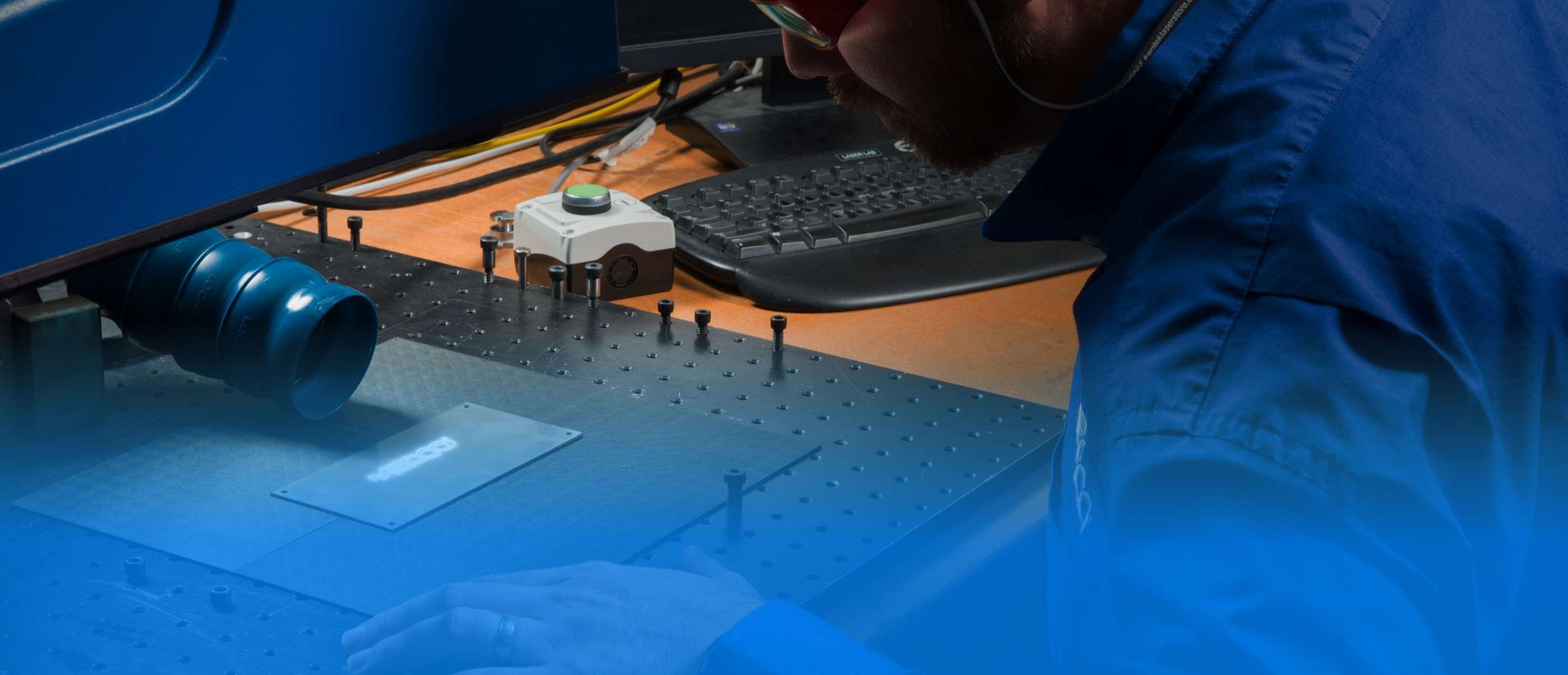
MOPA laser marking - send us your part, we'll MOPA-mark it free
We MOPA-mark your actual part - color on stainless and steel, black on anodized aluminum, low-HAZ on thin-wall and sensitive substrates - then send it back with a full feasibility report. No obligation.
- MOPA marked on your actual part - color, black-on-anodized aluminum, and low-HAZ samples on your material
- Detailed feasibility report - pulse duration, frequency, and the right MOPA fiber laser configuration for your application
- Marks where standard fiber fails - thin-wall, anodized, coated, and heat-sensitive substrates with controlled heat input
Trusted by industry leaders
Trusted by Manufacturers Who Can't Afford a Bad Mark
What really blows everybody away is how perfectly your system integrated with our database. Going into this project, the other companies we talked to just didn't get it. But you understood where we were going and what had to be done.



How MOPA marking works at Brady
From First Conversation to Production-Ready MOPA Marks
You don't need to know the exact pulse-duration, frequency, or fluence yet. That's our job - your part is the proof.
Tell Us What You're MOPA-Marking
Fill out the form or call. Material (anodized aluminum, titanium, stainless, coated, thin-wall...), geometry, mark type - that's all we need to get started.
- Engineer responds within 1 business day
- MOPA-marked on your real part, plus comparison samples in other technologies
- Text, serial, color/grayscale, barcode, logo, 2D Data Matrix
We MOPA-Mark It - You Get Proof Samples
We MOPA-mark your actual part across multiple pulse-duration and frequency settings, plus a comparison fiber mark, then send it back with a full feasibility report.
- Multiple MOPA pulse settings + comparison fiber mark
- Your part returned with real sample marks
- Written recommendation with the MOPA parameters that worked
- No commitment.
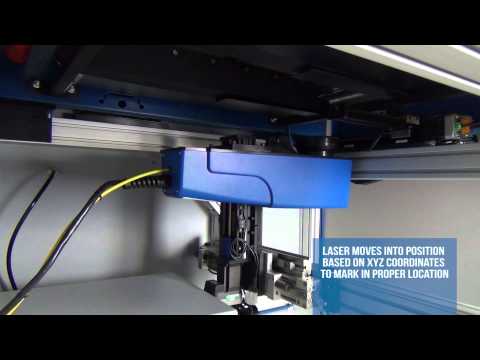
We Build the Right MOPA System
LightWriter VP MOPA desktop, SMARTmark OEM VP MOPA rack-mount, or a fully integrated MOPA cell - matched to your production environment.
- MOPA configuration based on your test results
- PLC, ERP, and Cognex vision verification ready
- Installation, training, 2-year warranty
Why MOPA fiber laser marking
What's Your MOPA Marking Challenge?
MOPA fiber lasers solve marking problems that standard fiber lasers can't. Pick your challenge to see the application, the MOPA-specific solution, and proof it works.
Standard Fiber Lasers Are Burning, Warping, or Discoloring Your Parts
A standard CW fiber laser runs at a fixed pulse duration (≈100 ns) and high peak power. On thin-wall parts, anodized aluminum, painted surfaces, or sensitive substrates that creates a wide heat-affected zone (HAZ) - warping, discoloration, surface charring, or coating damage. The mark is visible, but the part is no longer acceptable.
- Master Oscillator Power Amplifier architecture decouples pulse duration from peak power - you tune them independently
- Short pulses (1-10 ns) deliver lower fluence per pulse - controlled energy, minimal HAZ
- Adjustable frequency up to 1 MHz lets you trade depth for surface temperature
- Same wavelength (1064 nm) and mark types as standard fiber - drop-in replacement for the marking station, not the workflow
Honeywell Aerospace - SMARTmark VP MOPA + 20W Fiber, SAP-integrated, with vision verification. The smaller footprint replaced a bulky YAG flatbed, and the controlled-HAZ marks ended the nameplate rework that was costing $2,500+ per incident. Read case study →
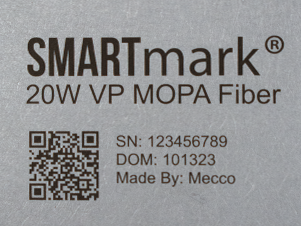
You Need Color Marks - or Black-on-Anodized Aluminum - That Standard Fiber Can't Deliver
Standard fiber lasers ablate the anodized layer on aluminum, leaving a gray etch that breaks the surface treatment. They can't reliably produce color marks on stainless or steel. For brand-critical surfaces - consumer electronics, medical instrument handles, aerospace nameplates, automotive interior trim - the result looks unfinished. You need marks that are permanent and beautiful.
- Black on anodized aluminum: short pulses anneal the substrate beneath the anodized layer - the coating stays intact, the mark is jet-black and permanent
- Color on stainless and titanium: tuned pulse parameters grow controlled oxide layers - black, amber, blue, green, and silver are all achievable on the same machine
- Aesthetic-grade contrast: high-frequency, short-pulse settings produce photo-quality grayscale logos and serial numbers
- Same part, same fixture: change the pulse program - not the machine - between mark types
Jiffy-tite - 45M+ anodized-aluminum automotive fittings/year marked at 0.8 sec/part. Time/date stamp + anti-counterfeit logo, integrated into a cam-driven rotary dial, AIAG-compliant. Payback under 2 years. Read case study →
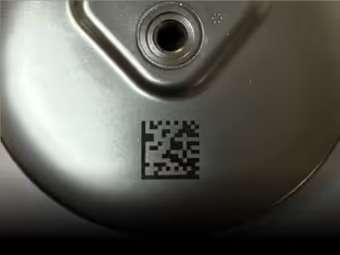
Your Substrate Can't Take the Heat - But the Mark Still Has to Be Compliant
Medical implants need UDI Data Matrix codes that survive sterilization without compromising the substrate. Electronics and PCBs need traceable serials marked without thermal damage to nearby components. Painted, plated, and thin-wall parts need permanent marks that don't crack the coating or warp the substrate. Standard fiber lasers are too hot for the job.
- Medical (titanium, stainless): short-pulse, low-fluence MOPA settings produce sterilization-safe Data Matrix codes that meet FDA UDI without altering the implant surface chemistry
- Electronics (PCB, components): tuned MOPA settings mark substrates without raising the surrounding board temperature - safe near sensitive components
- Coated and painted parts (MIL-STD-130, AIAG): controlled-HAZ marks preserve the coating while delivering grade-A 2D Data Matrix
- Thin-wall metal: low peak energy avoids the warping and back-side discoloration a standard fiber would cause
Honeywell Aerospace - SMARTmark VP MOPA on aluminum nameplates, integrated with SAP for serial generation, with Cognex in-machine verification. Marking-related returns ($2,500+/incident) dropped significantly. Read case study →
Your MOPA Marker Has to Live Inside Your Production Line
A standalone MOPA laser on a benchtop solves the marking-quality problem - but if it can't pull serial numbers from your ERP, talk to your PLC, and verify the mark before the part moves down the line, you've just added a manual step. You need the MOPA fiber laser and the integration around it.
- SMARTmark VP MOPA configured for direct ERP and MES database integration (SAP, Oracle, custom)
- FANUC robotic loading/unloading integration with the MOPA marking station
- Cognex vision verification reads MOPA marks back from the part - auto re-mark on grade failure
- EtherMark software handles serial generation, template management, and the PLC handshake
Pick Your MOPA Form Factor
Same VP MOPA laser source, two deployment patterns: a turnkey desktop enclosure, or an OEM unit built to integrate into your production line with PLC and vision verification. Not sure which fits? Send us your part and we'll spec it.
MOPA marking experience in your industry
Industry
Aerospace & Defense
Send us your part. Free sample marking on 5 technologies · 3–5 day turnaround · You get back: marked coupon, depth/contrast measurement, DPM grade per ISO 15415, recommendation memo.
MOPA Case Studies
MOPA marks, in production.
Customer stories using MOPA fiber laser marking on anodized aluminum, aerospace nameplates, and high-volume serialization. Click either card to read the full case.
 02
Read case study →
02
Read case study →
Need this integrated into your process?
Send Us Your Part - FreeMOPA Fiber Laser FAQ
Real Answers From the People Who Build MOPA Systems
MOPA-specific answers from our applications engineering, integration, compliance, and field service teams - including the uncomfortable ones. If your question isn't here, send us your part and we'll answer it one-on-one.
A standard Q-switched fiber laser has a fixed pulse duration (typically around 100 ns) and a fixed relationship between peak power and pulse frequency. You can change power and frequency, but not the pulse shape.
A MOPA (Master Oscillator Power Amplifier) fiber laser separates the pulse-generating stage (oscillator) from the amplification stage. That means pulse duration is independently adjustable - typically anywhere from 1 ns to 200 ns - and frequency can reach up to 1 MHz. You can dial in short pulses for low heat input and high peak power, or long pulses for deeper marks. Same wavelength (1064 nm), same beam path, vastly more control.
In practical terms: MOPA can produce color marks on stainless and steel, black marks on anodized aluminum without removing the coating, low-HAZ marks on thin-wall and sensitive parts, and photo-quality grayscale - all on the same machine. A standard fiber can't do any of those reliably.
Yes - this is the application MOPA was built for. MOPA's short-pulse settings anneal the aluminum substrate beneath the anodized layer rather than ablating the coating, producing a jet-black, high-contrast mark while the anodization stays intact.
A standard fiber laser will burn through the coating and expose bare aluminum - a gray, etched, unfinished-looking mark. Send us your anodized part and we'll run a MOPA vs. standard-fiber side-by-side so you can see the difference before you specify equipment.
Yes. By tuning the pulse duration, frequency, and fluence, MOPA controls the oxide-layer thickness that forms during marking. Different oxide thicknesses refract light at different wavelengths, producing visible color.
On stainless steel and titanium you can reliably achieve black, amber, blue, green, and silver from the same machine. Repeatability depends on the substrate finish and alloy - we calibrate the parameters for your specific material when you send us a sample.
One note on durability: color marks are surface oxide layers, so they're best for visible/branding marks rather than marks that need to survive aggressive post-process (heat treat, acid passivation). For permanent traceability on the same machine, switch back to the standard MOPA black/gray mark.
Yes - MOPA is the typical recommendation for UDI marking on titanium and stainless steel medical devices. The reasons:
- Sterilization-safe: short-pulse MOPA marks leave a smooth surface that doesn't trap contaminants and survives autoclave, gamma, and ethylene oxide cycles
- Low HAZ: minimal thermal alteration of the substrate - critical for implantable devices where surface chemistry matters
- Compliant Data Matrix: we encode UDI per FDA 21 CFR 830 (DI + PI), verify the mark with Cognex to AIM DPM-1-2006, and deliver Grade B or better
Send us a sample implant and we'll mark it with MOPA, dot-peen, and standard fiber so you can specify the right method - and see the difference under a stereo microscope.
Yes. BAE Systems uses our fiber laser and dot peen systems for Bradley vehicle component marking under MIL-STD-130N. For coated, painted, or sensitive substrates that a standard fiber would damage, MOPA delivers the same compliant 2D Data Matrix with controlled heat input.
We size the Data Matrix per the standard, encode Issuing Agency Code + Enterprise Identifier + Serial Number per Construct 1 or 2, and verify with Cognex to AIM DPM-1-2006 Grade B or better. MIL-STD-130N Change 1 syntax is supported. If you're supplying to a specific DoD program with supplementary requirements, send us the contract data requirement and we'll match it.
Honest answer: it depends far more on how you deploy the system than on the laser itself. A MOPA source is a premium configuration - the pulse-control hardware costs more than a basic fixed-pulse fiber - so it won't be your cheapest option, but the bigger price drivers are wattage, enclosure class, verification, and automation level.
The main cost tiers, lowest to highest:
- Turnkey desktop (LightWriter VP MOPA enclosure) - the entry point
- OEM / line-integrated (SMARTmark OEM VP MOPA with PLC + vision) - mid-range
- Custom automated cell (robotic loading, dual-head, EtherMark) - the top end
We don't hide behind "contact us," but we also won't quote a number that misleads you - the spread across those tiers is real. Send us your part and your production context and we'll scope a configuration and quote it explicitly, itemized.
Typical turnaround is 3-5 business days from the day your part arrives at our Cranberry, PA applications lab. That includes marking your part with multiple MOPA pulse-duration, frequency, and power settings; photographing the results; writing the feasibility report with the parameters that worked; and shipping the part back with sample marks.
One anodized aluminum, titanium, stainless, or thin-wall part is enough for a basic MOPA feasibility test. Three to five with different finishes is ideal. A Brady Marking applications engineer follows up within 1 business day of form submission.
Quick decision guide:
- Choose MOPA when you need color marks, black-on-anodized aluminum, low-HAZ on sensitive substrates, photo-quality grayscale, or a single machine that can do both aesthetic marking and standard compliance marking
- Choose standard fiber when you only need permanent marks on bare metal and want the lowest cost per mark - it's the workhorse
- Choose dot peen when you need the deepest possible mark (forged steel, post-paint survival, anti-counterfeiting depth) and you don't care about visual finish
- Choose UV laser when you're marking plastics, polymers, PCBs, or other heat-sensitive non-metals where any fiber would burn or melt
If you're not sure, send us your part and we'll mark it with MOPA and the other technologies that could apply, then write you a feasibility report with the right recommendation.
Get Started - Free Sample Program
Send Us Your Part.
We'll MOPA-Mark It Free.
No spec sheets to decode. No sales pitch. Just your actual part, MOPA-marked in our applications lab - with pulse-duration and frequency settings tuned to your substrate - then returned with a written feasibility report.
Request received
A Brady Marking applications engineer will review your request and follow up within one business day.
Not Ready for a Form? Call an Expert.
Talk directly to a Brady Marking applications engineer about your material, your process, and your requirements.
Explore the full system lineup
Specs, models, and the closest alternatives — pick a system to see the detail.
Brady - Send us your part. We'll mark it free.
Send Us Your Part
Send Us Your Part.
We'll Mark It Free.
Your actual part tested across 5 technologies. Returned with real marks + a written recommendation.
Send Us Your Part — Free2 minutes. No sales pitch. An engineer responds in 1 business day.
Request Received!
A Brady Marking engineer will contact you within 1 business day with a prepaid shipping label.





Ready to See Proof?
Your part back. Real marks. Written recommendation. No invoice.
Send Us Your Part — Free 1-262-271-7903