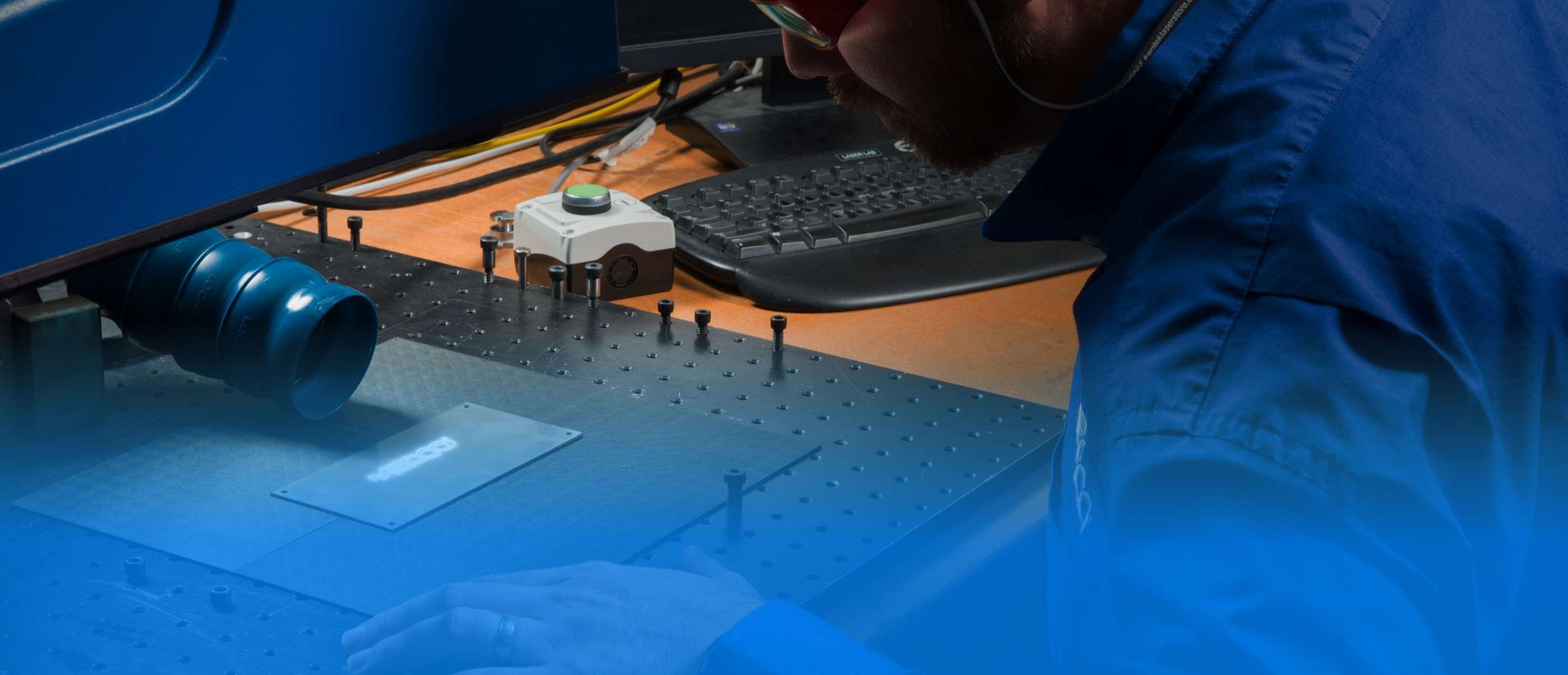
Send us your part - we'll laser etch it free and prove it lasts
Industrial laser etching removes a thin surface layer for a permanent, weather-resistant mark on almost any metal. We'll etch your actual part and send it back. No obligation.
- Permanent and weather-resistant - laser etching removes a thin surface layer for a durable mark on nearly any metal part
- Fiber and MOPA power - SMARTmark® lasers from 20W to 200W, 100,000+ hour life, air-cooled, zero consumables
- Etch or anneal - your call, with data - we'll mark your part both ways so you can see contrast, depth, and durability side by side
Industrial laser etching, specifically
Laser Etching vs. Annealing vs. Engraving - and Which Your Part Needs
"Laser etching" gets used loosely. Here's what it actually means, how it differs from annealing and deep engraving, and how we prove the right one on your part.
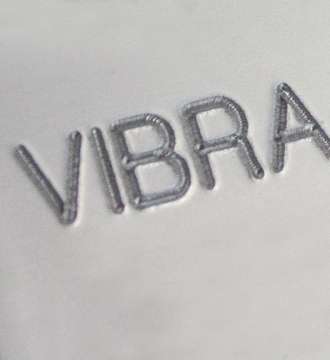
Laser etching uses a focused laser (typically a fiber or MOPA laser) to remove a thin layer of the surface, creating a permanent, weather-resistant, durable mark on almost any part. It's distinct from annealing - which discolors stainless without removing material (corrosion-safe, used in medical) - and from deep engraving, which removes more material for the deepest marks. The right choice depends on your material, durability requirement, and whether the surface can be altered.
Our SMARTmark® Fiber and VP MOPA lasers (20W-200W, air-cooled, 100,000+ hour life, no consumables) handle all three modes on steel, stainless, aluminum, titanium, brass, and copper. For organics like wood, glass, and rubber, a CO2 laser etches instead. We mark your actual part across the relevant modes so your engineer specifies with evidence.
- We laser-etch your actual part at multiple settings and, where useful, show annealing and deep-engraving side by side
- You get a depth and contrast comparison plus the exact parameters - so you specify the mark your spec needs, not an over-aggressive one
- Etched 2D data matrix and serials are verified for readability with Cognex vision to a DPM grade
- You run the returned part through your own paint, e-coat, or field exposure to confirm it survives
A multinational power-management OEM fighting counterfeits had Brady laser-etch overt and covert marks into each circuit breaker's molded case with a SMARTmark® Fiber laser, rotary indexing, and integrated vision pulling data from their ERP. Read the anti-counterfeiting case study →
Trusted by industry leaders
Trusted by Manufacturers Who Can't Afford a Bad Mark
What really blows everybody away is how perfectly your system integrated with our database. Going into this project, the other companies we talked to just didn't get it. But you understood where we were going and what had to be done.



Solving marking challenges for
Etched Marks That Outlast the Part. Pick One.
Hover for the headline · Click opens the case study
How it works
From First Conversation to Production-Ready Marks
You don't need to know which technology is right. That's our job.
Tell Us What You're Marking
Fill out the form or call. Material, geometry, mark type - that's all we need to get started.
- Engineer responds within 1 business day
- Marked across up to 5 technologies
- Text, serial, barcode, logo, 2D Data Matrix
We Mark It - You Get Proof Samples
We mark your actual part across multiple technologies and send it back with a full feasibility report.
- Multiple technologies and settings marked on your part
- Your part returned with real sample marks
- Written recommendation included
- No commitment.
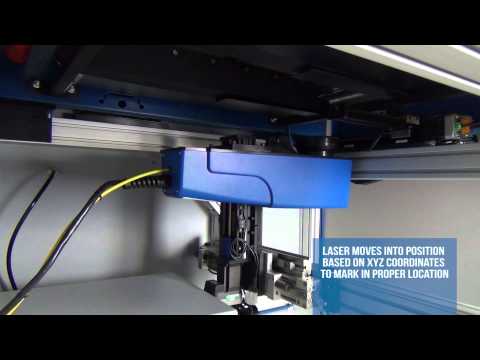
We Build the Right System
From benchtop to fully automated cell - matched to your production environment.
- Configuration based on your test results
- PLC, ERP, and vision verification ready
- Installation, training, 2-year warranty
Challenges, solutions & technologies
What's Your Marking Challenge?
Select your challenge to see the problem, the technology that solves it, and proof it works.
Your Marks Aren't Surviving the Process
Marks fade after painting, become unreadable after heat treatment, or corrode in the field. Parts get rejected, reworked, or returned - and every incident costs time, money, and customer trust.
- We mark your part with multiple settings we're confident will survive your post-process - paint, powder coat, heat treat
- Multiple technologies and parameter settings marked on your real part
- You get the marked part back to run through your own process and confirm the mark survives
- Dot peen for maximum depth, fiber laser for surface-level high-contrast marks
Komatsu - Deep dot peen marks that survive full spray paint process on heavy-duty construction components. Read case study →
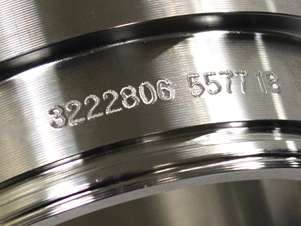
A Customer or Regulation Now Requires Traceability
A tier-one customer, a regulatory body, or an internal quality initiative now requires permanent, machine-readable traceability marks on every part. You need a system that meets the standard - and proves it.
- 2D Data Matrix, serial numbers, barcodes, and human-readable text
- Cognex vision verification built into the marking cell - 100% in-machine read/grade
- AIAG-standard mark grades verified automatically
- Direct database and ERP integration - no manual data entry
Honeywell Aerospace - SAP-integrated fiber laser with 100% in-machine verification. Quality incidents ($2,500+ each) dropped significantly. Read case study →
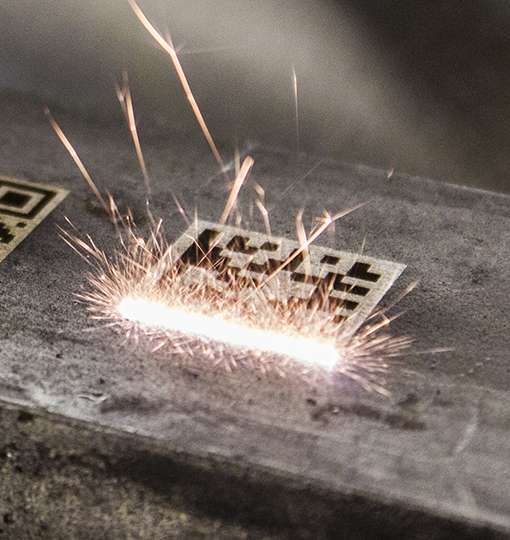
Hand Stamps, Labels, and Ink Are Costing You More Than You Think
Manual stamping is slow, injury-prone, and inconsistent. Inkjet marks fade and expose you to counterfeiting. Labels peel off. Every one of these methods creates downstream quality and liability risk.
- Permanent marks that can't be peeled, faded, or counterfeited
- No consumables - no ink, no labels, no cartridges
- Eliminates hand stamping injuries entirely
- Anti-counterfeiting marks that can't be replicated or relabeled
Walkup Company - Replaced hand stamps with COUTH N-34 dot peen. 20 characters in 5 seconds. Eliminated injuries. Read case study →
You Need a System That Talks to Your Line, Not a Standalone Box
Your marking system needs to integrate into your existing production line - pulling data from your ERP, communicating with your PLC, and verifying marks automatically. A standalone box creates bottlenecks, manual data entry, and human error.
- Direct ERP and MES database integration (SAP, Oracle, custom)
- FANUC robotic loading/unloading integration
- Cognex vision verification - automatic read, grade, and re-mark
Find Your Marking Solution
Specs, materials, and use cases - pick a product to go deep. Not sure which you need? Send us your part and we'll tell you.
Experienced part marking for your industry
Industry
Aerospace & Defense
Send us your part. Free sample marking on 5 technologies · 3–5 day turnaround · You get back: marked coupon, depth/contrast measurement, DPM grade per ISO 15415, recommendation memo.
Case Studies
Proof from the line, not from a brochure.
Three customers. Three different marking technologies. Click any card to read the full case.
Need this integrated into your process?
Send Us Your Part - FreeFrequently Asked Questions
Real Answers From the People Who Build the Systems
Answers sourced from our applications engineering, integration, compliance, and field service teams - including the uncomfortable ones. If you don't find yours, send us your part and we'll answer it one-on-one.
Laser etching removes a thin surface layer for a permanent, weather-resistant mark. Engraving removes more material for a deeper mark (useful where the part is sandblasted or heavily handled). Annealing uses controlled heat to discolor the surface - typically stainless - without removing material, leaving a corrosion-safe mark preferred in medical.
All three are done with the same SMARTmark® fiber/MOPA platform - it's a settings question. Send your part and we'll show you the options so you specify the right one.
Because etching removes material, an etched mark generally survives post-processes and field exposure better than a surface-discoloration mark. But the honest answer depends on your material and exactly what the part goes through.
Send us your part and your post-process specs. We'll etch it at the settings most likely to survive, then return it so you can run it through your own line and confirm. For the most aggressive processes we'll also show you dot peen.
Metals are the core: steel, stainless, aluminum, titanium, brass, and copper with fiber and MOPA lasers. Organics - wood, glass, rubber, leather, cardboard - are etched with a CO2 laser instead. Reflective copper and gold may call for a green laser.
Tell us your material and we'll mark a sample on the right source.
Yes. We etch 2D data matrix, UID, VIN, serial numbers, logos, and human-readable text and verify readability with Cognex vision to a DPM grade. Etched marks are well suited to traceability standards (UDI, MIL-STD-130, AIAG B-4) where the mark must survive the life of the part.
Honest ranges, no hiding behind "contact us":
- Benchtop system - starts in the $25-40K range depending on configuration
- Integrated marking cell (vision verification, PLC/ERP integration) - typically $75-150K
- Custom automated cell (robotic loading, dual-head, Class 1 enclosures) - $200K+
Your quote depends on integration depth, verification requirements, and automation level - we quote explicitly and itemized. Your free sample comes back with a configuration recommendation, so the number is grounded in your actual part - not a brochure.
Typically 3-5 business days from when your part reaches our Cranberry, PA applications lab - etching across the relevant modes, photos, a feasibility report, and return shipping. A Brady Marking applications engineer follows up within one business day of your request.
Get Started - Free Sample Program
Send Us Your Part.
We'll Laser-Etch It Free.
Send your actual metal part and we'll laser-etch it on a SMARTmark® fiber or MOPA system - returned with the parameters, contrast, and a full feasibility report so you can confirm it lasts.
Request received
A Brady Marking applications engineer will review your request and follow up within one business day.
Not Ready for a Form? Call an Expert.
Talk directly to a Brady Marking applications engineer about your material, your process, and your requirements.
Explore the full system lineup
Specs, models, and the closest alternatives — pick a system to see the detail.
Brady - Send us your part. We'll laser-etch it free.
Send Us Your Part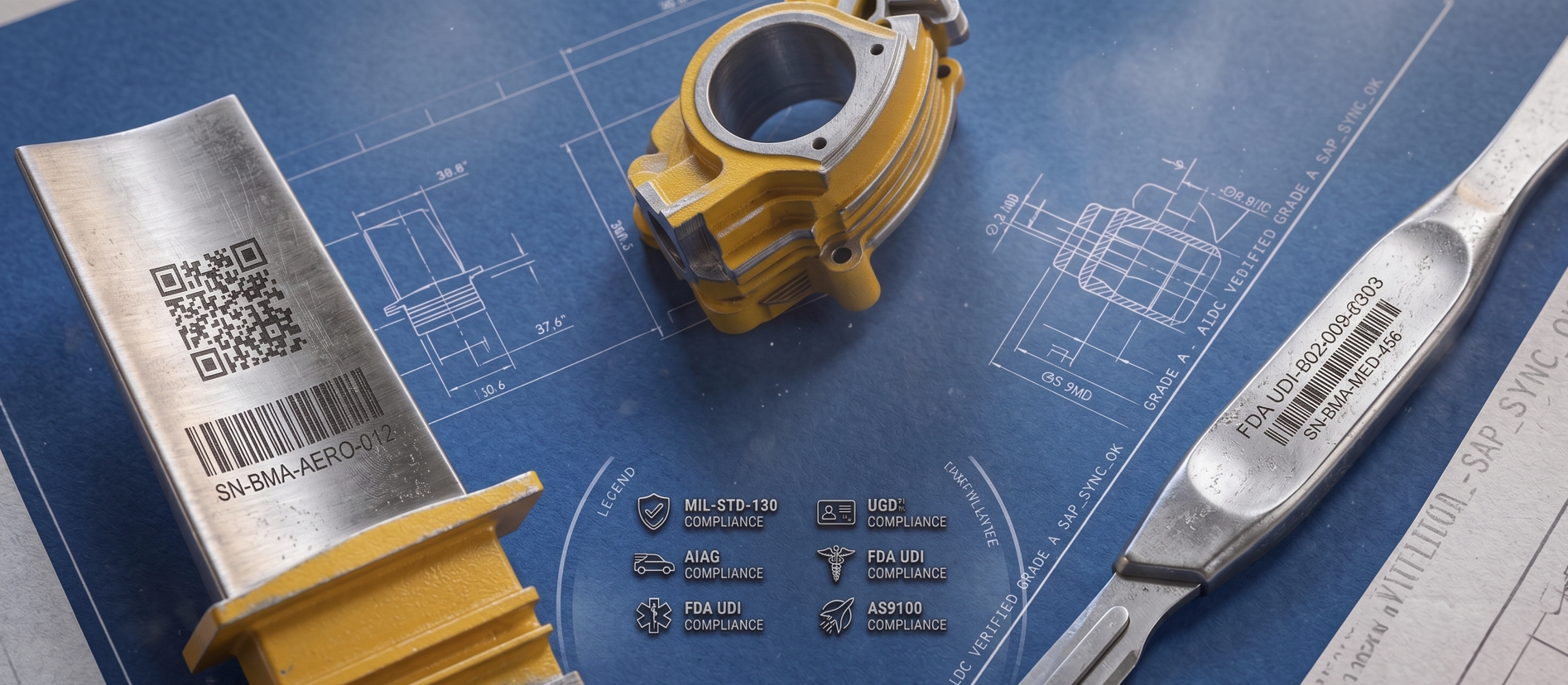
Send Us Your Part.
We'll Mark It Free.
Your actual part tested across 5 technologies. Returned with real marks + a written recommendation.
Send Us Your Part — Free2 minutes. No sales pitch. An engineer responds in 1 business day.
Request Received!
A Brady Marking engineer will contact you within 1 business day with a prepaid shipping label.



Ready to See Proof?
Your part back. Real marks. Written recommendation. No invoice.
Send Us Your Part — Free 1-262-271-7903